
Short circuit in house? Sparks, burning smell, or loud pop? Don’t reset the breaker. Discover the electrician’s emergency protocol to prevent fire and locate the fault safely.
+1 866-227-8161
Hey, I’m Mike.
I’ve spent the last 13 years crawling through attics, ripping open walls, and troubleshooting electrical nightmares—and if there’s one call that makes my phone ring at 2 AM, it’s this:
“There was a loud BANG, sparks flew from the outlet, and now half my house is dark. Is this a short circuit?”
I get it. You’re scared. You smell something burning. You don’t know if it’s safe to even flip a switch.
But here’s what you need to hear right now:
A short circuit is not just an “electrical problem.” It’s an active fire hazard.
And if you don’t respond correctly in the first 5 minutes, what started as a spark can become a full-blown house fire.
In this 5,300-word guide, I’ll walk you through exactly what to do if you suspect a short circuit in house—from the emergency steps to take before you even touch your panel, to how to prevent it from ever happening again.
You’ll learn:
- The deadly physics of a short circuit (and why it’s different from an overload)
- 5 warning signs you’ve probably ignored
- The exact 4-step safety protocol to follow when you see sparks
- When you must call 911 vs. when to call an electrician
- How to locate the fault without tearing down your walls
Because in my career, I’ve stood in living rooms where a short circuit started smoldering inside the wall for days—until it erupted in flames during dinner.
Don’t let your home be next.
What Is a Short Circuit? (And Why It’s More Dangerous Than an Overload)
Before we talk about fixes, you need to understand what you’re dealing with—because a short circuit is in a different league of danger than a simple tripped breaker.
The Physics of a Short Circuit
A short circuit occurs when a hot wire (live) makes direct contact with a neutral wire or ground—bypassing the normal resistance of your devices.
This creates a path of near-zero resistance, allowing thousands of amps to surge through the circuit in milliseconds.
For perspective:
- Your normal circuit: 15–20 amps
- A short circuit: 1,000–10,000+ amps
This massive current generates intense heat (up to 10,000°F)—hot enough to melt copper, ignite wood, and vaporize insulation.
Short Circuit vs. Overload vs. Ground Fault
- Overload: Too many devices → slow heat buildup → breaker trips in minutes
- Ground Fault: Hot wire touches ground → shock risk → GFCI trips in 1/40th second
- Short Circuit: Hot + neutral touch → instant massive surge → breaker trips in milliseconds (if it’s working)
Only a short circuit produces sparks, flashes, loud pops, or burning smells.
Why Modern Breakers Save Lives
Your circuit breaker is the only thing standing between you and a fire.
When a short occurs, the breaker’s electromagnet senses the massive current surge and instantly yanks the switch open—often before you even hear the pop.
💡 Critical Fact: If your breaker doesn’t trip during a short, it’s defective or mismatched—and your home is at extreme risk.
Common Causes of Short Circuits in Houses
- Rodent damage: Mice/rats chew through wire insulation
- Nail or screw penetration: Drilling into a wall and hitting a cable
- Loose wire connections: In outlets, switches, or the panel
- Faulty appliances: Internal wiring failure (e.g., old fridge, toaster)
- Water intrusion: Moisture in outdoor outlets or junction boxes
Why Older Homes Are at Higher Risk
Homes built before 1980 often have:
- Cloth-insulated wiring (degraded, brittle)
- Aluminum wiring (oxidizes, loosens over time)
- Outdated panels (Federal Pacific, Zinsco—known to fail silently)
These systems are more prone to shorts—and their breakers are less reliable at stopping them.
Warning Signs You’ve Already Got a Short Circuit
Most short circuits don’t happen without warning. Here’s what to watch for.
1. Loud “Pop,” “Bang,” or “Zap” Sound
This is the classic sign of a short circuit. It’s the sound of electricity arcing through air—like a mini lightning bolt inside your wall.
If you hear this, do not ignore it. Even if the breaker tripped and the power is off, the damage is already done.
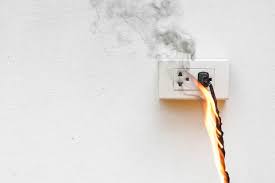
2. Visible Sparks or Flames from an Outlet or Switch
If you see blue-white sparks (not just a tiny static spark), that’s a dead short.
⚠️ If you see flames: Evacuate immediately and call 911. Do not attempt to put it out with water.
3. Burning Smell or Discolored Outlets
A smell of burnt plastic, ozone, or fish (from overheating insulation) means wires are melting.
Check outlets and switches for:
- Brown or black scorch marks
- Swollen or warped faceplates
- Warmth to the touch
These are fire ignition points.
4. Repeatedly Tripping Breaker (Even with Nothing Plugged In) (
If you reset a breaker and it trips instantly—even with all devices unplugged—you have a wiring short, not an appliance issue.
This means the fault is inside your walls, ceiling, or panel—and it will not fix itself.
5. Flickering Lights on Multiple Circuits
While flickering on one circuit might be an overload, flickering across multiple rooms can indicate a loose main service connection or panel-level short—a critical emergency.
What to Do IMMEDIATELY If You Suspect a Short Circuit (H2)
Your actions in the first 5 minutes determine whether this ends as a minor repair—or a disaster.
Step 1: Turn Off Power at the Main Breaker
Do not reset the tripped breaker.
Go to your main electrical panel and flip the main breaker to OFF.
This cuts power to your entire house, stopping any ongoing arcing or heating.
🔥 If you see smoke or flames: Skip this step. Evacuate and call 911.
Step 2: Do NOT Use Water or Standard Fire Extinguishers
Electrical fires cannot be put out with water—it conducts electricity and can electrocute you.
Only use a Class C fire extinguisher (rated for electrical fires). If you don’t have one, evacuate.
Step 3: Call a Licensed Emergency Electrician
Do not call a handyman. Do not wait until morning.
Call a 24/7 emergency electrician and say:
“I had a loud pop, sparks, and a burning smell. I suspect a short circuit.”
Most offer same-day service for critical faults.
Step 4: Document the Damage (For Insurance)
Before the electrician arrives:
- Take photos of scorched outlets, melted panels, or damaged devices
- Do not touch anything—leave evidence intact
- Note the time, sound, and smell in writing
This helps with home insurance claims (most policies cover short-circuit damage if wiring was up to code).
What NOT to Do
- Never reset a breaker that tripped instantly
- Never ignore a burning smell
- Never assume “it’s just old wiring”
- Never use tape, glue, or DIY fixes on damaged outlets
Electricity doesn’t negotiate. It only obeys physics—and physics says: short circuit = fire risk.
How Electricians Locate and Repair a Short Circuit
You might think finding a short means tearing down walls. It doesn’t—when you know what you’re doing.
Step 1: Circuit Tracing and Isolation
A pro will:
- Map the affected circuit
- Disconnect all devices
- Use a circuit tracer to isolate sections of the wiring
- Narrow the fault to a specific wall or junction box
This avoids unnecessary demolition.
Step 2: Megger Testing (Insulation Resistance Test) (H3)
The megger (megohmmeter) sends a high-voltage pulse through the wires to measure insulation integrity.
- Good insulation: >100 megaohms
- Damaged insulation: <1 megaohm (indicates short path)
This pinpoints the exact location of the fault—often within inches.
Step 3: Common Repair Scenarios
- Faulty outlet: Replace outlet ($100–$150)
- Rodent-damaged cable: Install junction box + new wire segment ($200–$400)
- Nail penetration: Reroute cable around the damage ($250–$500)
- Panel-level short: Replace bus bar or breaker ($150–$300)
Step 4: Safety Upgrades After the Repair
After fixing the short, a good electrician will recommend:
- AFCI breakers (detect future arc faults)
- GFCI protection in wet areas
- Torque check on all connections (NEC 110.14(D))
Why DIY Repairs Are Dangerous
Trying to “fix” a short yourself can:
- Leave hidden damage that reignites
- Create new shorts from improper splicing
- Void your home insurance if unpermitted
- Risk electrocution during testing
This is one job never worth the risk.
How to Prevent Short Circuits in Your Home
Prevention is cheaper, safer, and smarter than repair.
1. Protect Against Rodents
- Seal cracks and holes in your foundation
- Use steel wool + caulk around pipe entries
- Store food in airtight containers
- Consider ultrasonic repellents in attics/basements
Rodents cause thousands of house fires every year in the U.S.
2. Be Careful When Drilling or Nailing
- Use a stud finder with AC wire detection
- Avoid drilling above or below outlets/switches
- If you hit a wire, stop immediately and call an electrician
A single nail can pierce insulation and cause a short months later.
3. Upgrade Old Wiring and Panels
If you have:
- Cloth-insulated wiring (common pre-1960)
- Aluminum wiring (1965–1973)
- Federal Pacific or Zinsco panels
Schedule a professional inspection. These systems are time bombs.
4. Install AFCI Breakers
Arc Fault Circuit Interrupters (AFCIs) detect dangerous arcs that standard breakers miss.
- Required by NEC in bedrooms, living rooms, hallways
- Cost: $40–$50 per breaker + installation
- Prevent ~50% of electrical fires
5. Regular Electrical Inspections
Homes over 25 years old should get a full electrical inspection every 5 years.
An electrician can spot:
- Loose connections
- Degraded insulation
- Overloaded circuits
- Outdated components
It costs $150–$250—but can save your life.
Frequently Asked Questions (Expanded)
Can a short circuit fix itself?
No. A short circuit is a physical damage to the wire or device. It will not heal. Ignoring it only increases fire risk.
How much does it cost to fix a short circuit?
- Simple outlet fault: $100–$200
- Wall wiring fault: $250–$500
- Panel-level fault: $300–$600
- Full circuit reroute: $500–$1,200
Most electricians charge a flat diagnostic fee ($100–$150) applied to repairs.
Will homeowners insurance cover short circuit damage?
Yes, usually—if:
- The wiring was up to code
- The damage was sudden and accidental
- You used a licensed electrician for repairs
Get a written report from your electrician for the claim.
Can I test for a short circuit myself?
You can identify symptoms (smell, sparks, tripping), but locating the exact fault requires professional tools (megger, circuit tracer).
Do not use a multimeter on live circuits unless you’re trained—it’s extremely dangerous.
How long does it take to fix a short circuit?
- Simple outlet: 30–60 minutes
- Wall fault: 2–4 hours
- Panel fault: 1–2 hours
Emergency electricians often provide same-day service.
Is a short circuit the same as a power surge?
No.
- Short circuit: Internal fault → massive current → fire risk
- Power surge: External spike (lightning, grid switch) → fries electronics
Use surge protectors for surges; breakers/AFCIs for shorts.
What does a short circuit smell like?
- Burning plastic (most common)
- Ozone (sharp, metallic smell—like after a lightning storm)
- Fishy odor (from overheating electrical components)
If you smell this, turn off power and call a pro.
Final Word from Mike
I’ve repaired shorts caused by squirrels in Austin attics.
I’ve replaced panels melted by aluminum wiring in Miami condos.
And I’ve stood in Chicago kitchens where a nail from a picture frame started a fire behind the drywall.
A short circuit isn’t just a “glitch.”
It’s electricity escaping its path—and it will find a way to burn your house down if you let it.
So if you hear a pop, see sparks, or smell burning—
Don’t reset. Don’t ignore. Don’t wait.
Turn off the main power.
Call a licensed electrician.
And protect what matters most.
Because when it comes to short circuits,
there are no second chances.