
Dead outlet? Don’t panic. Our complete, step-by-step guide shows you how to safely diagnose and fix any dead electrical outlet in your home, from checking breakers and GFCIs to replacing the unit yourself. Get your power back in minutes
Démarrer agent
Hey there, it’s your trusted local electrical expert. For over two decades, I’ve been the guy people call when things go dark. And if there’s one single, universal cry for help I’ve heard from countless homeowners across the United States, it’s this: “My outlet is dead!” It’s a moment of modern-day panic. You plug in your phone after a long day, or the coffee maker for that essential morning brew, and you’re met with… absolute nothingness. The silence is almost louder than an alarm.
Before your mind races to scenarios of costly repairs and walls being torn apart, I want you to take a deep, calming breath. I’m here to personally walk you through the exact, methodical process I use every single day to diagnose and fix a dead outlet. The truth is, a surprising majority of these cases—I’d say well over 80%—are resolved with a simple, logical fix that you can absolutely handle yourself in less time than it takes to finish a cup of coffee.
This guide is my brain on paper. It’s the culmination of thousands of service calls, from historic homes in New England to modern constructions in California. We’re going to go far beyond the basics. We’ll cover the simple stuff, the intermediate steps, and even touch on the complex scenarios so you know precisely when to be the hero and when to call for backup. Let’s empower you with knowledge and get your power flowing again.
Part 1: The Detective Work – My Go-To Initial Diagnostic Steps
Before a single tool comes out of my bag, I put on my detective hat. Rushing to conclusions is the fastest way to waste time and create more problems. A few minutes of careful, logical investigation is the most professional thing you can do. This is the bedrock of all electrical troubleshooting.
Is It the Device or the Outlet? The First Rule of Troubleshooting
This seems almost too obvious to mention, but I assure you, it solves a significant number of “dead outlet” calls. Appliances, chargers, and power adapters have their own internal components, and they fail far more often than the wiring in your walls.
My Process:
- Unplug the device (let’s say it’s a toaster) from the suspect outlet.
- Carry that exact same toaster to a different outlet in a different room—one you were just using or know for a fact is working (the one with the TV or a lit lamp is a perfect candidate).
- Plug it in and test it.
- If the toaster still doesn’t work: Congratulations! You don’t have an electrical problem; you have a toaster problem. You just saved yourself a lot of hassle.
- If the toaster works perfectly: Okay, now we know the problem lies with the original outlet. You’ve successfully isolated the fault. This is a crucial first step.
The Simple Lamp Test: My Old-School, Foolproof Confirmation Method
While you can use any device, my personal favorite for testing is a simple, cheap table lamp with a standard incandescent or LED bulb. Why a lamp?
- Visual Confirmation: You get an immediate, undeniable visual cue. It’s either on or it’s off. There’s no ambiguity.
- Low Power Draw: A lamp is a low-wattage device. It won’t trip a sensitive breaker, which gives you a pure test of the outlet’s ability to deliver power.
- Safety: It’s a sealed, simple device. You just plug it in.
Plug the trusty lamp into the dead outlet and flick its switch. If it remains dark, you have officially confirmed: the outlet is not providing power. Now, our investigation can truly begin.
The Breaker Panel Pilgrimage: My First Trip is Always to the Heart of Your System
Your circuit breaker panel is the central nervous system of your home’s electrical grid. It’s usually a gray metal box located in a garage, basement, utility closet, or sometimes even a bedroom closet in older apartments. This panel’s job is to protect your home from fires by automatically shutting off power when it detects a problem, like an overload or a short circuit.
How to Read and Reset a Breaker:
- Locate the Panel: Open the metal door. You’ll see rows of black switches. Each switch is a breaker that controls a specific “circuit” or area of your home.
- Look for the Outlier: Scan the switches. Most should be in the “ON” position. You are looking for one switch that is in the “OFF” position, or—and this is the one that tricks most people—stuck in a middle, neutral position. It won’t be aligned with the others.
- The Correct Reset Procedure: This is critical. You cannot simply flip a tripped breaker back to “ON.” It won’t engage. You must first push the switch firmly all the way to the “OFF” position. You’ll often feel a solid “click.” Then, you can flip it back to the “ON” position, where you should feel another, more satisfying “click.”
- Go Check the Outlet: Return to the scene of the crime and test the outlet again with your lamp. If it lights up, you’ve found your culprit! The question now becomes: why did it trip? Was someone using a hairdryer and a space heater at the same time? If it was a one-time event, you’re likely fine. If it trips again immediately, you have a more serious issue that we’ll discuss later.
The Great GFCI Hunt: Finding the Secret Savior in Your Home
If the breaker was fine, my mind immediately jumps to the GFCI. A Ground Fault Circuit Interrupter is a special type of smart outlet designed to prevent electrocution in areas where electricity and water might meet. You’ll recognize them by the “TEST” and “RESET” buttons located on their face.
Why a GFCI is Often the Hidden Culprit:
The National Electric Code (NEC) mandates that a single GFCI outlet can protect itself and all the other regular outlets that are wired “downstream” from it on the same circuit. This means a tripped GFCI in your master bathroom could be the reason the outlet in your guest bedroom is dead. The power flows through the GFCI to the other outlets.
Your Mission:
- Think About Location: The dead outlet is in a bedroom. Is there a bathroom nearby? Check it for a GFCI.
- Check All “Wet” Areas: Methodically search all your bathrooms, your kitchen (check near the sink and along the countertops), your garage, your basement, and any outdoor outlets.
- Press “RESET”: When you find one, press the “RESET” button firmly. You should hear a click, and sometimes a small light on the outlet will turn on.
- Test Again: Go back and check the dead outlet. More often than not, it will have magically sprung back to life.
The “Switched Outlet” Phenomenon: The Simple Mistake We All Make
This is particularly common in living rooms and bedrooms, especially in homes built from the 1960s onward. To save on the cost of installing an overhead ceiling fixture, builders would often wire one of the two receptacles in an outlet to a standard wall switch near the door. The idea was for the homeowner to plug in a floor or table lamp and use the wall switch to control it.
Before you declare the outlet dead, perform a simple check:
- Plug your lamp into the top receptacle of the outlet.
- Go to the entrance of the room and flip every single light switch on and off.
- If the lamp doesn’t turn on, unplug it and repeat the process with the bottom receptacle.
It’s a simple oversight, but it happens to the best of us.
Part 2: Gearing Up – The Tools I Never Work Without and Why
If you’ve gone through all of Part 1 and the outlet is still dead, it’s time to consider opening it up. But I cannot stress this enough: you do not proceed without the right tools. Using the wrong tool is not only ineffective, it’s incredibly dangerous. This is my essential, non-negotiable safety kit.
Your Absolute Best Friend: The Non-Contact Voltage Tester (NCVT)
If you buy only one tool from this list, make it this one. An NCVT is a pen-sized electronic tester that detects the presence of an electrical field around a wire, switch, or outlet.
- How it Works: You simply hold the tip of the tester near the source. If voltage is present, it will light up (usually red) and emit an audible beeping sound. The closer it gets to the source, the faster it beeps.
- Why it’s a Lifesaver: It allows you to confirm that the power is OFF before your fingers or tools ever touch a potentially live wire. It is the ultimate safety check. I use mine to test a wire even after I’ve flipped the breaker. Trust, but verify.
The Unsung Heroes: Insulated Screwdrivers
A standard screwdriver is a solid piece of metal—a perfect conductor for electricity. If your screwdriver tip touches a live wire while you’re holding the handle, your body can become the path to ground. An insulated screwdriver has a thick, heavy-duty layer of non-conductive plastic or rubber that extends from the handle all the way down the shaft, leaving only the very tip exposed. This provides a critical layer of protection against accidental shock. You’ll need both a Phillips head and a flathead.
The Step-Up Tool: A Digital Multimeter
While an NCVT gives you a simple “yes/no” answer about power, a multimeter gives you a precise, quantitative measurement. It’s the tool I use to diagnose truly weird problems.
- What it Tells You: You can measure the exact voltage (is it the full 120V or a weak 30V?), check for continuity (is a wire broken somewhere inside the wall?), and test resistance.
- When You Need It: If an outlet seems to work intermittently, or if your lights are dimming and flickering on that circuit, a multimeter can help you determine if you have a loose neutral wire or a poor connection somewhere along the line. For a homeowner, a basic, auto-ranging digital multimeter is an excellent investment.
The Workhorses: Wire Strippers, Cutters, and Pliers
If you’re going to replace the outlet, you need to work with the wires.
- Wire Strippers: This tool has a series of gauged holes to cleanly cut and remove the plastic insulation from a wire without nicking or damaging the copper conductor inside. Using a knife or the wrong tool can damage the wire, creating a future failure point.
- Needle-Nose Pliers: Their long, thin jaws are perfect for bending the ends of the copper wires into the small hooks needed to loop them around the terminal screws on an outlet. They’re also great for straightening bent wires.
The Essential Accessory: A Headlamp or Flashlight
You cannot fix what you cannot see. It’s a simple truth. Many electrical panels are in dimly lit corners, and the moment you turn off the circuit breaker, you might plunge the room you’re working in into darkness. A good LED headlamp is my preference because it keeps both of your hands free to safely hold tools and parts. Don’t try to do this work holding a phone in your mouth.
Part 3: The Usual Suspects – Common Causes for Dead Outlets in American Homes
After thousands of service calls, I’ve developed a mental checklist of the most likely culprits. These issues cover the vast majority of problems you’ll encounter in a typical American home.
The Overload Trip: The Most Common Culprit Explained
As we discussed, a tripped breaker is the #1 cause. But why does it trip? The most common reason is a simple overload. Every circuit is designed to handle a maximum amount of electrical current, measured in amps. For most standard home circuits, this is 15 or 20 amps. If you plug in devices that collectively draw more than that limit, the breaker does its job and trips to prevent the wires from overheating.
- Classic Scenario: A 15-amp bedroom circuit. Someone is running a 1,500-watt space heater (about 12.5 amps) and then decides to vacuum with a 10-amp vacuum cleaner. The total draw (22.5 amps) far exceeds the 15-amp limit, and click—the breaker trips.
The Faulty GFCI: Understanding the Sensitive Soul of Your Electrical System
A GFCI works by constantly monitoring the flow of electricity in and out of the circuit. If it detects even a minuscule imbalance (as little as 4-5 milliamps)—which could mean electricity is leaking out and shocking a person—it trips in a fraction of a second. These sensors are sensitive and can wear out over time, causing “nuisance tripping” or failing altogether. If a GFCI won’t reset, or if it trips every time you plug something in (even a low-power lamp), the GFCI outlet itself has likely failed and needs to be replaced.
The Silent Danger: Loose Wiring and Back-Stabbed Connections
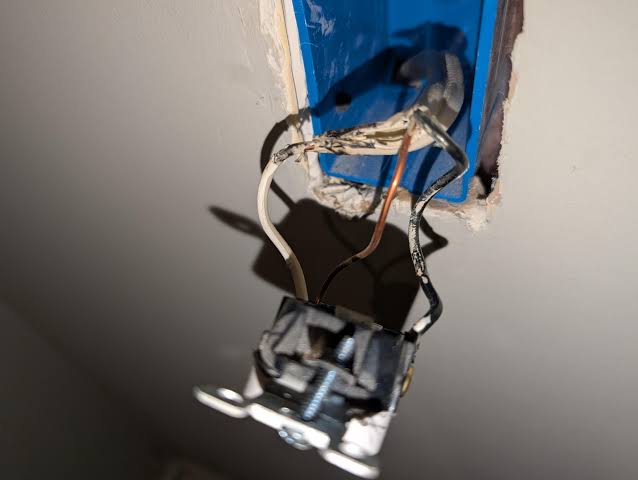
This is by far the most dangerous cause of a dead outlet. Over time, due to thermal expansion and contraction (wires heating up and cooling down) and minor vibrations, the screw terminals holding the wires on the back of an outlet can become loose.
- A more sinister problem is “back-stabbing.” Cheaper, faster installation methods involve simply pushing the straight end of a wire into a spring-loaded hole on the back of the outlet. These connections are notoriously unreliable. They loosen over time, creating a tiny air gap. Electricity has to “arc” or jump across this gap, which generates immense heat, melts the plastic outlet, and can easily start a fire inside your wall. If I find a dead outlet is due to a loose connection, I always recommend replacing all back-stabbed outlets on that circuit with outlets where the wires are securely fastened under the screw terminals.
The Outlet Is Simply Worn Out: The End of a Mechanical Lifespan
An outlet is a mechanical device. The internal metal contacts that grip the prongs of your plug are under constant spring tension. Over thousands of insertions and removals, these springs weaken.
- The Telltale Sign: Do your plugs feel loose? Do they sag or fall out of the outlet? This is a clear indication that the outlet is worn out. This loose connection is not only annoying; it’s an arcing and fire hazard, just like a loose wire. If you see any cracks on the face of the outlet or any dark, sooty discoloration, its service life is over. It’s time for a replacement.
The Overloaded Circuit: A Chronic Condition in Older American Homes
Homes built before the 1980s were simply not designed for our modern digital lifestyle. It was common for a single 15-amp circuit to power all the outlets in two or even three bedrooms. Today, each of those rooms might have a computer, a large monitor, a printer, speakers, and multiple device chargers. This constant, heavy load puts a strain on the entire circuit, leading to frequent breaker trips and accelerated wear and tear on all components, eventually causing an outlet to fail.
Part 4: The Main Event – A Safe, Meticulous Guide to Replacing an Outlet
If you’ve done your detective work and are confident the outlet itself is the problem, and you’re equipped with the right safety tools, you can absolutely do this. Follow these steps meticulously. Do not skip a single one.
Step Zero: The Unskippable Safety Protocol – Cut the Power and Verify
- Go to your circuit breaker panel. Identify the breaker that controls the circuit you’re working on. If your panel isn’t labeled (a common issue), you may need a helper. Have them watch the lamp you plugged into the dead outlet’s neighbor (which should be on the same circuit) while you flip breakers one by one until the lamp goes out.
- Turn the breaker to the full “OFF” position.
- Lock it out. Place a piece of strong tape (I prefer red electrical tape for visibility) over the breaker switch. You can even write “WORK IN PROGRESS – DO NOT TOUCH” on it. This prevents a well-meaning family member from accidentally turning the power back on while you’re working.
- Return to the outlet and VERIFY. Use your non-contact voltage tester. Insert the tip into the vertical slots of both the top and bottom receptacles. The tester should remain silent and dark. I do this every single time, without fail. It’s the mark of a professional.
Step 1: The Disassembly – Exposing the Wiring
- Using your flathead screwdriver, unscrew the single, small screw in the middle of the outlet’s faceplate. Set the plate and screw aside.
- You will now see the metal “yoke” (the top and bottom tabs) of the outlet, which is secured to the electrical box in the wall with two longer screws. Use your Phillips or flathead screwdriver to remove these two screws.
- Gently grip the outlet by the yoke and pull it straight out from the wall. The attached wires should have enough slack to allow you to pull it out a few inches. Do not yank on it.
Step 2: The Inspection – Identifying Your Wires
Take a clear look at the wires connected to the old outlet. In virtually all modern U.S. homes, you will see:
- Hot Wire(s): One or more wires with BLACK plastic insulation. These carry the electrical potential from the breaker. They will be connected to the BRASS or gold-colored screws on the side of the outlet.
- Neutral Wire(s): One or more wires with WHITE plastic insulation. These complete the circuit, carrying the current back to the panel. They will be connected to the SILVER-colored screws on the opposite side.
- Ground Wire(s): One or more wires that are either BARE COPPER or have GREEN insulation. This is a safety wire that provides a path for electricity to go to the ground in case of a fault. It connects to the single GREEN screw, usually at the bottom of the outlet.
- Take a Picture: Before you disconnect anything, take a quick, clear photo with your phone. This is your backup plan if you get confused.
Step 3: The Disconnect and Prep – Removing the Old and Preparing the New
- Loosen the terminal screws on the old outlet and unhook the wires. If the wires were “back-stabbed,” you may need to twist and pull the outlet to release them, or look for a small release slot next to the hole.
- Inspect the ends of the wires. Are they nicked, brittle, or discolored? If so, use your wire cutters to snip off the damaged end and use your wire strippers to strip about 3/4 of an inch of fresh insulation off, exposing clean, bright copper.
- Using your needle-nose pliers, bend a small, clockwise-facing hook on the end of each insulated wire.
Step 4: The Connection – Wiring the New Outlet Correctly
This is where you match the colors. Black to Brass, White to Silver, Green to Green.
- Hook the black wire’s loop around one of the brass screws. Make sure the hook wraps in the same direction the screw tightens (clockwise). This ensures the loop tightens itself as you screw it down.
- Tighten the brass screw firmly. The wire should be snug, with no wiggle room.
- Hook the white wire’s loop around one of the silver screws and tighten it firmly.
- Hook the bare copper or green ground wire around the green screw and tighten it firmly.
- Give each wire a gentle tug to ensure it is secure.
Step 5: The Reassembly and Final Test – The Moment of Truth
- Carefully fold the wires back into the electrical box in an accordion-like fashion. Gently push the new outlet into place.
- Secure the outlet to the box using the two long mounting screws you removed earlier.
- Screw the faceplate back on.
- Go back to your breaker panel, remove your safety tape, and flip the breaker back to the “ON” position.
- Return to your newly installed outlet and test it with your lamp. If it lights up, take a bow. You’ve just safely and successfully completed the job.
Part 5: The Hard Stop – When to Call a Licensed Electrician in Your Area
My goal is to empower you, but also to keep you safe. A true expert knows their limits. There are clear signs that indicate a problem is beyond a simple DIY fix and requires the diagnostic tools and experience of a licensed professional.
Red Alert: Burning Odors, Scorch Marks, or Melting
This is a non-negotiable, stop-everything-and-call-a-pro situation. A burning smell (which can smell like fishy plastic or ozone) or any black/brown discoloration around the outlet’s slots means that dangerous arcing has occurred. This indicates a severe failure that has generated enough heat to pose a significant fire risk. Do not even attempt to touch it. Turn off the breaker and call an electrician.
The Stubborn Breaker: If It Keeps Tripping Immediately
If you reset the breaker and it trips again the moment you turn it on, or as soon as you plug something in, you have a persistent fault. This could be a “short circuit” (a hot wire is touching a neutral or ground wire) or a “ground fault.” Hunting this down requires specialized tools and knowledge of how circuits are run through the walls.
The Aluminum Wiring Anomaly (Common in Homes Built 1965-1973)
During a period of high copper prices, many homes were built using solid aluminum wiring instead of copper. Aluminum oxidizes differently, expands and contracts more, and requires very specific installation techniques and special connectors (the purple wire nuts, for example) to be safe. Improperly handled aluminum wiring is a major fire hazard. If you open an outlet and see silver-colored wires connected to it, stop immediately and call an electrician who has experience with aluminum wire remediation.
When Your Gut Says “No”: If You’re Not 100% Confident
There is absolutely no shame in this. Electrical systems are complex and can be intimidating. If you open the box and see a confusing mess of wires, if you feel unsure about any step, or if your gut is just telling you this is over your head, listen to it. Your safety and peace of mind are worth far more than the cost of a service call.
The Ancient Panel: Dealing with Old or Complicated Electrical Systems
If your electrical panel is a rusty, ancient box with fuses instead of breakers, or if the wiring looks like a chaotic spaghetti monster, it’s best left to a professional. Older systems have their own quirks and potential dangers that require a seasoned hand to navigate safely.
Part 6: Proactive Homeownership – Keeping Your Electrical System Safe and Sound
The best way to fix a problem is to prevent it from ever happening. A little bit of proactive maintenance and mindfulness can dramatically improve the safety and reliability of your home’s electrical system.
The Extension Cord Rule: They Are a Temporary Solution, Not a Permanent Fixture
Extension cords are designed for short-term, temporary use. They are not rated for the continuous load of, say, an air conditioner or a computer workstation. If you find yourself relying on an extension cord day after day, it’s a clear sign that you need a permanent outlet installed in that location. Overloaded extension cords are a leading cause of house fires.
The Art of Load Balancing: Don’t Put All Your Eggs in One Circuit
Be mindful of what you’re plugging in and where. High-draw appliances include anything that generates heat (space heaters, hair dryers, toasters, coffee makers) or has a large motor (vacuums, blenders). Try to run these on different circuits. For example, don’t run your portable heater in the office while the laser printer is warming up if they are on the same circuit.
The Annual Walk-Through: A Quick Inspection for Your Outlets
Once a year, take a few minutes to walk through your home and visually inspect your most-used outlets.
- Check for Warmth: After using a high-draw appliance, unplug it and briefly touch the face of the outlet. It should be at room temperature. If it’s warm or hot, that’s a sign of a poor connection.
- Check for Discoloration: Look for any yellowing, browning, or scorching.
- Check for Grip: As you plug and unplug a device, does the outlet grip the prongs firmly? Or does the plug feel loose and saggy? A loose grip means a worn-out outlet.
The Modern Upgrade: Why You Should Consider USB and Smart Outlets
When an outlet needs replacing, see it as an opportunity.
- USB Outlets: For a few dollars more, you can install an outlet that has both traditional receptacles and built-in USB-A and/or USB-C ports. This eliminates the need for bulky charging adapters and is incredibly convenient for charging phones, tablets, and other devices.
- Smart Outlets: These outlets connect to your home’s Wi-Fi, allowing you to control them via an app on your phone or with voice commands (e.g., “Hey Google, turn off the living room lamp”). This is great for security, convenience, and energy savings.
Know The Law of the Land: A Note on Local Building Codes
The National Electrical Code (NEC) provides the baseline for safety in the U.S., but your state, county, or city can have additional, stricter requirements. While replacing a single outlet is typically considered basic maintenance, more extensive work (like adding a new circuit) will almost certainly require a permit and an understanding of these local codes. When in doubt, a licensed local electrician is your best resource to ensure all work is done safely and legally.